
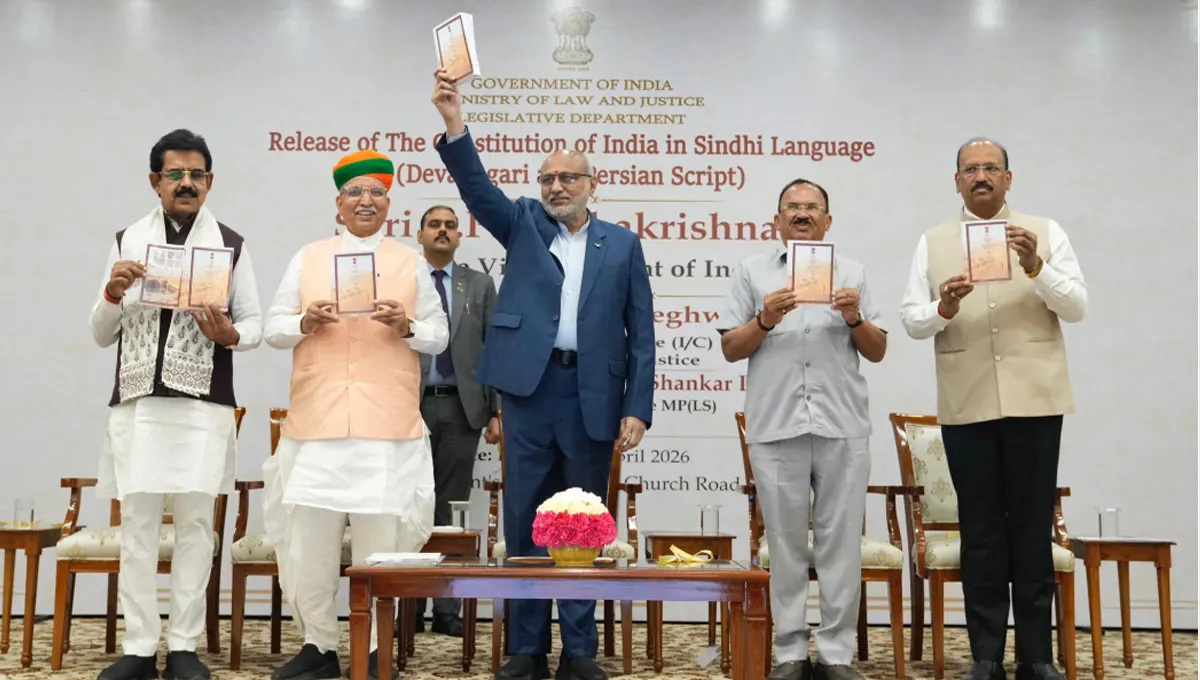
Vice President C. P. Radhakrishnan released the Constitution of India in Sindhi language in Devanagari and Persian scripts, marking a key step toward linguistic inclusivity and stronger democratic participation.
New Delhi: In a significant step toward promoting inclusivity, C. P. Radhakrishnan released the Constitution of India in the Sindhi language at the Vice President’s House in New Delhi. The Constitution has been published in both Devanagari and Persian scripts, ensuring wider accessibility for the Sindhi-speaking community.
The Vice President expressed his happiness while releasing the document on the occasion of Sindhi Bhasha Diwas. Highlighting the rich historical journey of the Sindhi community, he noted that the Sindhi language stood as a symbol of resilience and unity, especially during the challenging times following the Partition of India.
C. P. Radhakrishnan emphasized that making the Constitution available in Sindhi is an important milestone in advancing linguistic inclusivity in the country. He stated that such initiatives allow citizens to understand the Constitution in their mother tongue, thereby strengthening democratic participation and public trust in governance.
He further added that in a diverse and multilingual country like India, efforts to make essential documents accessible in regional languages play a vital role in connecting people with the democratic framework. The availability of the Constitution in Sindhi will not only help preserve the language but also empower future generations with a better understanding of their rights and responsibilities.
Several dignitaries attended the event, including Union Minister of State (Independent Charge) for Law and Justice and Parliamentary Affairs Arjun Ram Meghwal, Speaker of the Rajasthan Legislative Assembly Vasudev Devnani, and Member of Parliament Shankar Lalwani. They appreciated the initiative and described it as a strong reflection of India’s unity in diversity.
Experts believe that such steps are crucial in making the Constitution accessible to every section of society. By bridging language barriers, the initiative strengthens democratic values and encourages greater civic engagement.
Overall, the release of the Constitution in Sindhi marks a progressive move toward a more inclusive and participatory democracy, reinforcing the government’s commitment to respecting and promoting India’s linguistic diversity.